Warning: This page contains references to rape, csa, violence, torture, drugs and profanity
As always, whilst I do enjoy the disturbing media I discuss on this blog, I absolutely recommend discretion whenever you look into these things for your own, and theres nothing wrong with being turned off by any of the above topics. Its interesting to consume fucked up shit and push our limits but theres nothing wrong with staying within your limits.
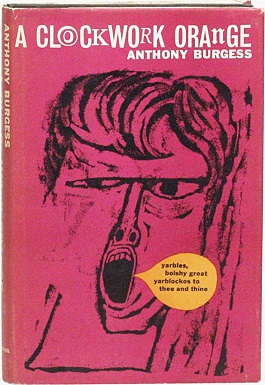
“A Clockwork Orange” (1962) is the first novel by Anthony Burgess, and one he has since disowned, and seems somewhat upset at it remaining his most famous work (definitely helped by a. Controversy and b. The film by Stanley Kubrick I’ll also probably talk about in the films section).
Burgess described the book as a jeu d’esprit, a French term to refer to a work that was done quickly, in the spirit of an idea rather than a proper passion project, with it only taking 3 weeks total to be written. Frankly, I love the book and regardless of Burgess’s distaste to his work in hindsight, I think its a fascinating piece of political literature that raises some really fucking horrible questions about youth violence, rape culture and reformation.
It takes place in the near future as of publishing, a date we are now past and thankfully didn’t come to fruition. We see the world through the lens of a young gangster named Alex, whose life entirely seems to take place within the incredibly violent and dangerous criminal life of… somewhere in England (not specified). Alex and his “droogs” (gang) all speak in Nadsat, a fictional language based in a combination of english and russian slang, with around ⅕ of the words in the book being entirely fictional, as it is entirely narrated from Alex’s perspective, not just the dialogue. As a result, it is a little hard to read but I think that makes it all the more interesting as a novel, as well as leading to Alex being a somewhat unreliable narrator. Something incredibly messed up to keep in mind is that Alex is only 15 years old, and most of the other criminals are in their teenage or young adult years, really lending the the idea that this is a part of the world in such economic and authoritative ruin that youth seem to run the streets, as well as showing the derangement of children if they get up to shit like this at such a young age.
Alex is a complete sociopath, who spends his days drinking “milk-plus” a type of milk laced with extreme narcotics, listening to classical music, specifically Beethoven who he refers to as “Lovely Ludwig Van” and engaging in what is referred to as “ultra-violence”, a term for absolute mayhem of any sort, from destruction of public property, murder and infamously, rape.
The book is split into 21 chapters in England. Unfortunately, most American publishers refused to publish the book, but when Burgess found one who finally would, he was forced to remove the 21st chapter for reasons we’ll get to. This sucks for multiple reasons, but one is that the chapter number was very deliberately chosen, as the ultimate theme of the book is adolescence. 21 is the age that we are considered proper adults, not just by a legal definition but in terms of completed maturity in the eyes of the public, and the book is further split into three parts, seven chapters each.
Plot
The first part takes place within the city and is entirely focused around getting us - the reader - to hate Alex as much as possible, reading as he and his droogs do all sorts of awful shit, stealing, taking drugs, drunk driving, beating the homeless, fighting a rival gang, and in the most infamous scene, bluff their way into a couples house, before beating the husband close to death, and collectively gang raping his wife, forcing him to watch.
After all that, which takes place within a single night, we see Alex go home, and see how he has abused his own parents to be under his will, putting drugs in their food to let them go to sleep without hearing him blast Beethoven as he stays up all night.
Later, there's a truly deplorable scene, the worst in the book, to the point of being drastically changed in the movie, despite everything currently mentioned not being. Alex meets two pre-teen girls, around 10-12 assumedly. He invites them to his flat, where he drugs and rapes them. As you can assume, it's one of the worst in the book conceptually, but the Nadsat in this scene is so confusing I didn’t realise that was what happened until watching a Youtube explanatory video after having read it, as I assumed he groomed them into coming in, made them uncomfortable with requests for sex before they left. That should go to show how confusing Nadsat is - I knew he was a creep to the girls but didnt realise he fucking raped them. In the film, the scene still exists but was significantly changed in two ways: First, the girls are of age in appearance. They could still be teenagers as Alex is also played by an adult in the film despite still being 15, but regardless, they’re of HIS age at the very least. And more importantly, they’re consenting, despite the earlier rape scene being more or less the same in the film. The scene is an entirely consentual orgy in the film, making it moreso a show of Alex’s manipulative charisma and generally being a bit of a sexual deviant, as opposed to showing him as a fucking psychopath in the book. Its interesting, as those two simple changes transform the scene from the disturbing highlight of the book, into barely noticeable in the film compared to all the actual crimes committed.
Part 1 ends with the group pulling their bluffing once again to enter a house, similar to the previous gang rape, except this time, Alex ends up less successful with the woman inside, beng left to fend her by his lonesome, rather than in the previous attack. The result is him violently knocking out the woman on the floor, unsuccessful in what I assume would have been another sexual assault. When he leaves, he is double crossed by his group, who knock him out and leave him to be arrested, and to learn he accidentally killed the woman, resulting in serious charges.
Part 2 takes place within prison and there isn’t anywhere near as much to say about it, as it's mostly irrelevant other than one specific scene.
Alex stays in prison for 2 years, but due to good behaviour (no idea how such an utter degenerate managed that) is offered an opportunity to leave (btw keep in mind the only crime the law knew of was his breaking in and accidental killing of the woman, not all the other horrendous shit so he wasn't on a life sentence). All he has to do is participate in the “Ludovico Technique”, an experimental form of reforming demented humans, with minds targeted at committing violence. He agrees, leading to what is probably the most famous scene, even if not as brutal as any from Part 1.
Basically, the Ludovico technique is a form of aversion therapy, in which Alex is forced to watch films containing violence and rape whilst also being injected with nauseating drugs, conditioning him to become absolutely sick at the mere thought of the acts, and successfully too, but this obviously raises the question of if such a method of correction is correct. It makes him into a robot, unable to think for himself. A prevailing theme is that Alex hasn’t actually been reformed, he’s just as awful as ever, but simply physically unable to commit violence now - has he really changed?
It should also be noted, Beethoven’s Fifth Symphony is used as the soundtrack to one of the films, much to Alex’s displeasure as it means the track now causes him the same nausea as everything else. This will be relevant later.
Alex, now “reformed” is displayed to a group of investors (i assume at least) who watch as a man smacks him around, with Alex unable to defend himself due to being physically sick at the thought of violence, as well as a scantily clad woman inviting him on stage to do whatever he wants, but alex unable to, almost as if the films may have made him mentally castrated to the mere thought of sex. The officials are all pleased with the results, but the prison chaplain accuses them of rejecting free will. Regardless, Alex is let off free.
Part three takes place after prison, as we watch Alex struggle with life after having been “reformed”.
A lot happens in this part I’m going to skip over. The general thing is - Alex is fucked. This is the part where he gets his comeuppance for the awful shit he committed two years prior. He is beaten by other street thugs, unable to fight back at all, even being sick at the thought of the violence happening to him. Clearly the Ludovico Technique doesn’t consider self defense. He is abused by his former droogs, now employed as police officers, alongside their former rival gang leader. His parents have rented out his room and understandably want nothing to do with him. Alex is now homeless, beaten, abused and actively seeking some way of suicide that could be committed with his new brain. But you don’t feel bad for him - at least I don't. Any other protagonist and I’d feel awful in this moment but this is clearly happening to a man who did the very same to others earlier, After his ex friend police officers dump him after torturing him with a bucket of water, he stumbles to the door of an isolated house - which turns out to be the house of the couple he gang raped two years earlier, though now the wife is dead of injuries sustained from such brutal assault. The man, who we now see is a writer, still lives here, writing a book (Ill talk about the title later btw). He doesn’t recognise Alex as his wife's rapist and killer, but does recognise him as the “victim” of Ludovico from the news, and we see he’s a politician, with intentions to use Alex as a tool against his opponents with the Ludovico experiment being his anchor to show the lack of integrity of the opposing party. But beforehand, Alex accidentally reveals being involved in the home invasion, resulting in the man instead locking him in their attic and blasting Beethoven’s Fifth Symphony (remember?) resulting in Alex jumping out the window in a suicide attempt. Alex wakes in hospital, where politicians rush him, on the opposing side of the man from earlier, hoping to use the event as leverage in the opposite direction. Alex is offered a well paying job, reassurance of the man's arrest, as well as having the doctors remove his conditioning, bringing back his violent impulses fully. Photographers all snap photos of him as Alex daydreams of horrific ultra-violence once again, with the penultimate chapter ending with the line “I was cured all right”.
Now that's how the book ended for you Americans out there, and I believe that may still be the case these days, but I don’t know for sure. My British copy contains chapter 21 however.
BUT - let's look at this as a standalone ending first - I think it's interesting (and also it's worth noting the film is american made and therefore it also ends here so this is the more famous conclusion on that metric alone). The third act of the book is unapologetically political, and whilst the leanings of either party aren't actually stated, we don't need to know them. Both sides are presented as opportunistic and grabbing Alex to use as a tool for their own purposes. It doesn’t matter whether the man was left or right, or whether the ones at the hospital were. The point is, neither actually cared about Alex. Despite us still disliking Alex as a character, we are invited to dislike the politicians of this world just as much. I mean after all, they were the ones that let England get into the state it is in the first palace.
There’s also the matter of Alex’s reward for nothing in particular, as well as having his violent urges fully reimbursed. The message is clear: Nothing really changed, and he was rewarded for fuck all. We’re talking about a murderer, a rapist of both adults and FUCKING CHILDREN (editing note: I meant fucking here as an intensifier, not a verb), a serial drug user, a mass thief, and worst of all: someone who drinks milk by itself. And despite all of that, it's dropped, his urges are put back, and he’s offered a powerful job as long as he simply complies. It's a happy ending from our protagonist's perspective, but since we hate the protagonist, it isn’t really a happy ending.
However let's talk about the mysterious 21st chapter (well, mysterious for the yanks at least).
Alex is now 18 years old and working a decent job, but still speaking in Nadsat and relatively coming off as more of a geezer rather than a gangster. He no longer commits violence, but specifically due to not finding pleasure in it anymore. As earlier mentioned, he never really reformed. He simply doesn’t get off to it anymore. With that said, he’s in a new gang and preparing for yet another night of a crime, before he runs into Pete, one of his old gang members who has now fully reformed and has a wife, as well as speaking proper english (which if you haven’t caught onto yet, is a clear sign of better manners, since Nadsat is a bit of a symbol of youth rebellion, being slang and all).
Alex contemplates giving up crime for good, and potentially starting a family, but is hit by the pretty horrifying realisation that his own children could end up just as awful as himself, potentially worse due to the youth situation being no different as at the start of the novel.
Interestingly enough, this chapter wasn’t removed for being “controversial”, but rather since publishers believed US readers simply wouldn’t like it. Having the book end on a much more negative and dark note, with Alex implied to return to his urges for good, rather than considering true reformation was considered a more satisfying conclusion, and since the book was already so controversial, it's easy to see why Burgess said yes for the sake of getting the book published.
Confusing Title?
Ok, let's talk about the name.
“A Clockwork Orange” clearly has nothing to do with the events of the story, but has a couple potential meanings.
First of all, it should be mentioned the writer’s novel is named A Clockwork Orange, information I omitted earlier for dramatic effect now. The meaning within the story is never given however, and it's simply a strange nod to the reader.
Now it should be stated that “as queer as a clockwork orange” was assumed by Burgess to be cockney slang after he heard it in a London pub in 1945. With that said, no actual records of this phrase seem to exist before Burgess saying this - implying it may have been a one off line from a pub patron.
His second and in my opinion best explanation for the name is that its a pun on the fact the Malay word for man is orang, essentially implying that the proper name of the book is “A Clockwork Man”, which is further added to in the prefatory note to “A Clockwork Orange: A Play with Music” (which yes, is a thing) where he said the title was a metaphor for “an organic entity… turned into a mechanism”.
But what does he mean by that?
I see it as a critique of the concept of reformation to its core - with “reforming” a human basically being impossible, and the book showing the attempt to reform Alex just turning him into somewhat of a thoughtless robot, as if of clockwork. Not a true human.
When a man ceases his free will, he isn’t really a man, simply a clockwork orange.
A shiny and appealing object but simply “a toy to be wound up by either God or the Devil, or (what is increasingly replacing both) the State”, as Burgess put in the modern preface to the book.
Censorship and Banning
ACO has unsurprisingly, been the subject of an insane quantity of controversy. It was straight up banned in the US, leading to one bookseller actually being arrested for selling it in 1973 and in 1976, it was banned from a school in Colorado due to its language (of all the reasons to be banned, the very minor swearing is an interesting reason but sure). In 1982 it was removed from two libraries in alabama, and was most recently banned in a Texas school in - wait for it - 2024! It’s still happening!
The American Library Association ranked it the EIGHTH most frequently banned and challenged book in the US in 2025.
With that said, most controversy it hit towards the movie which despite cutting the worst scenes from the book, still showcased the stuff on screen, not only making it more accessible and famous but also making the violence and rape much more shocking and explicit, even though a surprising lack of nudity is shown, likely to make the scene more about the violence and control, rather than having a male-gazey element to it.
Reception
Generally the reception is pretty positive critic-wise, with most agreeing its a technical feat as far as Nadsat goes, with a book being written in a made up language, whilst still being implemented in each sentence in a careful fashion to make it so the reader still understands what it means. Thats not to be scoffed at, especially now that we know the book was made in less than a month, speaking as someone who’s tried writing before (you can read two of my unfinished novels on this site btw) - thats insanely fucking impressive.
Thats without mentioning the fact the book is really uncomfortable but succeeds in not being exploitative, keeping its descriptions to character reactions. Disturbing media often delves into voyeuristic territory, with books like The Slob or Tender is the Flesh giving stupidly in depth descriptions of awful shit to the point of feeling a little, well, fetishy. ACO avoids this, being a book about rape but still with no in depth descriptions of the human body in question, but rather the fucked up nature of whats actually happening.
Obviously some disliked the book more, with many considering the whole thing being written in Nadsat instead of keeping it to just dialogue to be incredibly unnecessary. Specifically, New Statesman referring to the book as being “a great strain to read” despite being very positive otherwise. Also some generally think the book is much more shallow and exploitative than I do.
But with all that said, perhaps the largest and most brutal critic of Burgess, was Burgess himself. As he later dismissed it, seeming almost embarrassed. He also now considered to violent content of the novel to “naueate” him, clearly considering it very tryhard.
Burgess published a biography of D. H. Lawrence, and in reference to the book “Lady Chatterley’s Lover” compared the book to ACO, saying “The book I am best known for, or only known for, is a novel I am prepared to repudiate: written a quarter of a century ago, a jeu d'esprit knocked off for money in three weeks, it became known as the raw material for a film which seemed to glorify sex and violence. The film made it easy for readers of the book to misunderstand what it was about, and the misunderstanding will pursue me until I die.”
He generally seems to believe he never should have created the novel, and deeply regretting it. In his words, I also see somewhat of a resentment to it being his legacy. None of us choose what we are remembered for. As of writing, no piece of media I’ve made has ever gone “viral” or been officially published, but I can still imagine how much it must suck for your first published work to be what people know you for. I’m thinking of the first youtube video I ever made right now. Oh god… could you even imagine?
Other Cool Shit
The film is the best known adaptation, but the book was also sort of adapted into cinema 6 years earlier. The Andy Warhol film “Vinyl” was an adaption of the book. Its pretty loose as far as adapting goes - or so the internet tells me. I haven’t actually seen it unlike the more famous film adaptation.The film did have permission, with the rights being secured for three thousand dollars but was very condensed and changed Alex’s name to Victor, as well as changing everyone elses names. The budget is unknown but supposedly very very low, to the point of many of the films extras just being actual strangers who weren’t aware of the cameras filming them on the streets.
ACO has also been adapted into musicals, such as a german adaptation that featured a score by punk rock band Die Toten Hosen which used Beethoven’s melodies in the music, later being released on the album Ein kleines bisschen Horroschau.
There was another musical adaption in 1990 by the Royal Shakespear Company. Its basically a very straight forward stage version of the movie, and received pretty negative reviews, with The Sunday Times hilariously referring to it as “A Clockwork Lemon”. Even Burgess hated it! And he wrote the script!
There are a bunch of other smaller adaptations, but they arent as high profile generally. The only one I find all too interesting is one in 2003 from Brad Mays, that was a multi-media stage adaptation and featured Vanessa Claire Smith as the protagonist, playing a gender bent Ale. The production used three video streams outputted to seven TVs on stage, one in the center and six surrounding it. Its generally a really strange idea but I kinda love it. I don’t know if the production was ever recorded but FUCK i wanna watch it so bad.
Conclusion
I hope my coverage of A Clockwork Orange was good, this is one of the longest I think I’ve written so far for this blog, and the first I’ve actually finished. I have a lot to say on it beyond the disturbing aspects and would recommend it, assuming you’re okay with some of the more objectionable content.
Disturbing Rating: 6/10
The rape is a LOT and the other violence generally makes this one really disturbing in theory, but the Nadsat makes it not actually that hard to read (in terms of violence that is, in terms of readabilitiy it makes it worse), as a lot of elements only become fucked up when you reflect on it and realise what you just read. Hence why I’d consider the movie a more disturbing piece of media despite actually taking out scenes.
Overall Rating: 9/10
Despite being disliked by the literal AUTHOR of the book, I think ACO is fantastic, an excellent experiment in violence, politics, philosophy and the english language. Not necessarily the best written book however. And also a little short.